Tube Amp Topologies
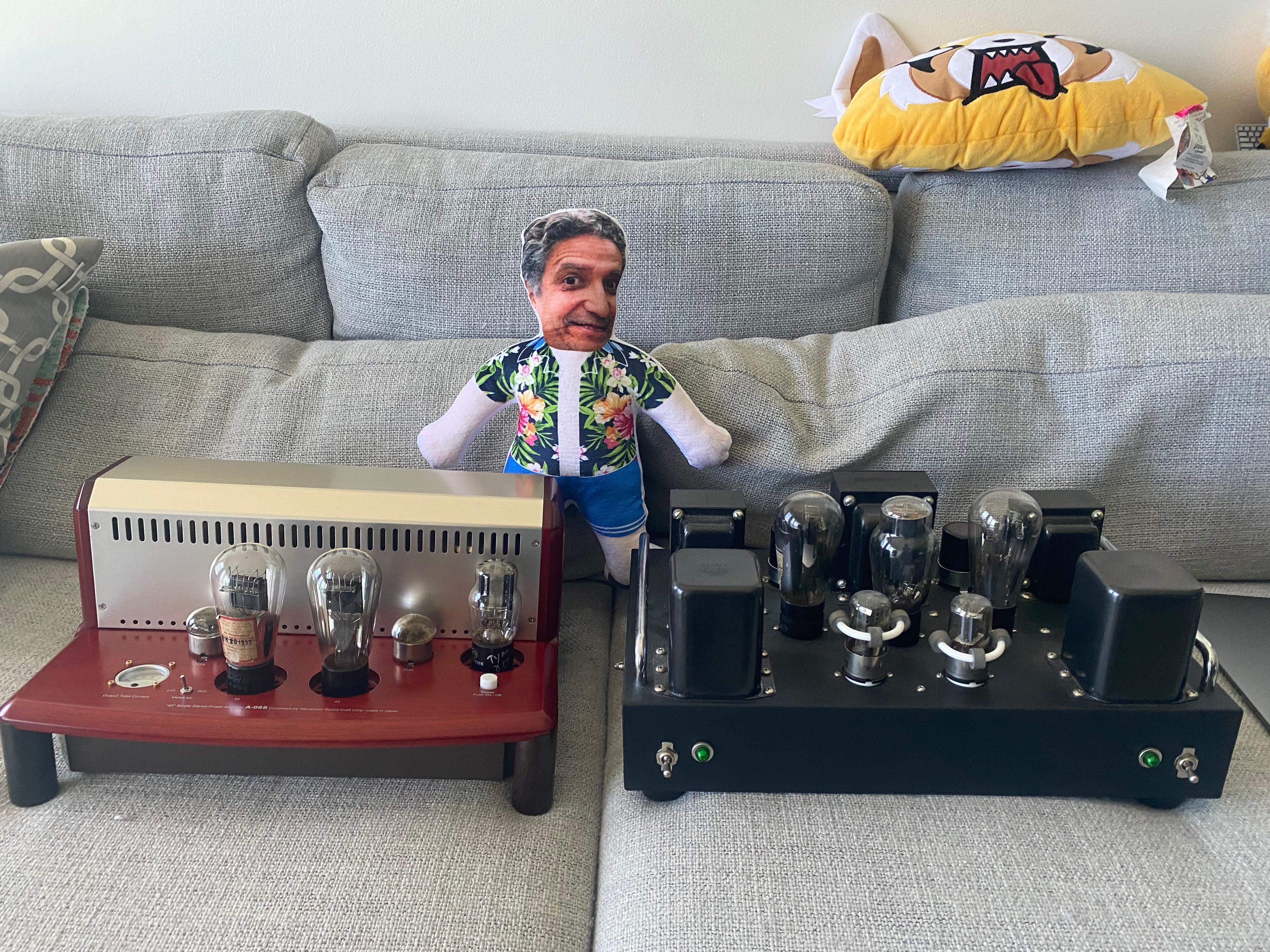
Four topologies, six implementations — five tube flavors and solid-state as the reference. The tube approaches share a signal-path philosophy (hot glass, high voltage, iron-coupled output) but deliver utterly different personalities at the speaker terminals; solid-state sits alongside them as the measurement-dominant counterpoint. The cells below compare the mechanics; the takeaway at the bottom compares the feel.
Side by side
| Aspect | Type 45 SET | 2A3 SET | 300B SET | PP Triode | PP Ultralinear | Solid State |
|---|---|---|---|---|---|---|
| Topology | One DHT, Class A | One DHT, Class A | One DHT, Class A | Two tubes, 180° phase, Class A/AB | Two tubes, screen tap ~40%, Class AB | Bipolar or MOSFET output stage; Class A, AB, or D |
| Typical power | 1.5–2 W | 3–4 W (single plate); ~15 W PP | 7–9 W | 15–30 W | 30–100 W | 50–500+ W |
| Plate voltage | ~250 V | ~250 V | ~350–450 V | varies | varies | ±35–100 V rails |
| Plate resistance (Rp) | ~1,700 Ω | ~800 Ω | ~700 Ω | — | — | Output Z typically <0.1 Ω |
| Filament | 2.5 V DHT | 2.5 V DHT | 5 V DHT | mix | mix | N/A |
| Distortion character | Lowest 2nd-harmonic at low level; very linear, clips gracefully | 2nd-harmonic dominant, slightly more than 45 | 2nd-harmonic; richer, warmer texture | Evens cancel; 3rd-harmonic dominant, lower THD | Between triode and pentode | Very low THD (<0.01%), but odd-order-dominant; Class AB can have crossover distortion at low level |
| Damping factor | Very low (~2) | Low (~3) | Low (~3–4) | Moderate (4–8) | Higher (8–15) | Very high (100–1000+) |
| Bass authority | Weakest; "delicate" | Better than 45; still gentle | Warmer, fuller bloom | Tighter | Tightest of the three tube types | Iron-fisted; controls any driver |
| Sonic reputation | Purest, most transparent mids; jewel-like, tiny presentation | Most neutral of the classic DHTs; punchier than 45 | Romantic, lush, holographic mids | Liquid mids with better grip | Most "hi-fi," neutral, controlled | Measurably accurate; often described as "clinical," "grainy," or "lacking tube magic" — camp-dependent |
| Sensitivity — near-field (~3 ft) | 92+ dB | 88+ dB | 85+ dB | 82+ dB | 80+ dB | Any (power is cheap) |
| Sensitivity — mid-room (~10 ft) | 100+ dB | 95+ dB | 93+ dB | 88–92 dB | 85–90 dB | Any (78+ dB) |
| Speaker type (the real constraint) | Crossover-less single-driver only (Lowther, PHY-HP, Voxativ) | Single-driver or very-high-sensitivity horn with benign network | Single-driver, or vintage horn (Altec, Klipsch Heritage) as a compromise | 2-way OK if impedance is reasonably flat | Most box speakers with standard crossovers | Anything — ribbons, stats, 2Ω minimum, reactive multi-way |
| Why (load character) | DF≈2: any crossover dip or phase swing bends FR — even 1.5-way designs dip 3-4Ω at the handoff | Same — slightly more headroom to mask it | Same — reactive loads still warp the top end | DF 4-8 tolerates mild Z swings | DF 8-15 drives reactive, Z-swinging loads with minimal FR effect | DF 100+: output voltage is functionally independent of load; FR stays ruler-flat into any Z curve |
| Tube / device cost | Scarce; NOS $200–600/pr; few current-production | Moderate; good current-production (EH, JJ, Sophia) | Plentiful current-production; NOS WE very expensive | Depends on tube | Depends on tube | Output transistors are commodity-cheap; cost is in the PSU, heatsinks, and chassis |
| OPT requirements | Gapped, must handle DC; small but high-quality critical | Gapped, DC bias; slightly larger than 45 | Gapped, DC bias; larger core | No DC; easier core | No DC; needs UL taps | None — direct-coupled or DC-servo output |
| Classic examples | Korneff 45 (the unicorn); WE 91A-style; Shindo; Yamamoto A-08 | Cary CAD-805 (triode mode), AN Kageki, Sun Audio | Cary 300B, AN Ongaku, many boutique | McIntosh MC30 (triode-strapped), Air Tight ATM-300 | Dynaco ST-70, Marantz 8B, most modern EL34/KT88 | Pass Labs Aleph / First Watt (Class A MOSFET); Krell KSA; Bryston; Hypex NCore (Class D) |
Running with the dogs — quick mental model
Type 45 is the most refined and most limiting DHT — you need the right speaker or it falls apart. 2A3 is the "sensible DHT": meaningfully more headroom with most of the 45's purity. 300B trades some transparency for warmth and usable power.
PP Triode keeps much of the single-ended tonal character while doubling the power and cancelling even-order distortion. Ultralinear is Hafler's compromise — screen taps give you ~80% of triode linearity with ~80% of pentode power, and the most flexible speaker match.
Solid state is the reference point for measurement: damping factor in the hundreds, output voltage independent of load, FR flat into anything. Whether that's what you want is the question — many listeners trade the ruler-flat precision for the harmonic texture of a DHT. The two aren't really on the same axis; they're answering different questions about what an amplifier is supposed to do.
One nuance on SPL. The "you need 100 dB speakers for a SET" rule of thumb assumes a mid-room listening triangle (~10 ft). Inverse square law gives +6 dB per halving of distance, so near-field listening (3-4 ft) relaxes the requirement by ~9-10 dB. A 95 dB speaker at 3 ft produces essentially the same SPL at your ears as a 100 dB speaker at 7 ft. This is why 45 SET systems in a desktop or recliner-plus-couch configuration can work with "only" 92-95 dB speakers, provided the impedance/phase constraint below is still met.
One nuance on matching. Sensitivity tells you how loud a speaker gets per watt; it does not tell you how well a SET will drive it. With a damping factor of 2–4, the amp's output voltage follows the speaker's impedance curve — any dip, peak, or phase swing becomes a bump in frequency response. In practice this rules out almost every speaker with a crossover. Even 1.5-way designs — a widebander plus a helper woofer crossed at 80-150 Hz with a single cap and coil — dip to 3-4Ω with ±45° phase at the handoff, and a SET will hear it. The honest answer is that SETs want crossover-less single-driver speakers (Lowther, PHY-HP, Voxativ, Fostex widebanders), and the Klipsch/Altec horn crowd accepts a known compromise in exchange for dynamics and headroom. PP triode widens the window; ultralinear opens it all the way.
Footnote · Filament heating.
Another advantage of low-power DHTs: their filaments tolerate AC heating well, and the best builds lean into it —
the Korneff 45 above is a canonical example. AC heating skips the rectifier and filter caps of a DC filament
supply, which advocates argue robs the signal of immediacy. Residual hum is nulled with a balance potentiometer
("humdinger") or a center-tapped filament winding. This benefit doesn't transfer to PP designs built around
indirectly-heated tubes (EL34, KT88, 6L6) — their heater is isolated from the cathode, so DC heating is a
non-issue and the sonic argument doesn't apply.
Confidence: high on power, Rp, and topology facts (well-documented tube specs). Sonic descriptions are consensus-level audiophile characterizations, not measurements.